 November 2026
A drawer wall built for bricks.
From stacked bins to three bays of 3D-printed MODULITH drawers, in a 2020 extrusion frame built around the way one LEGO® collection is stored.
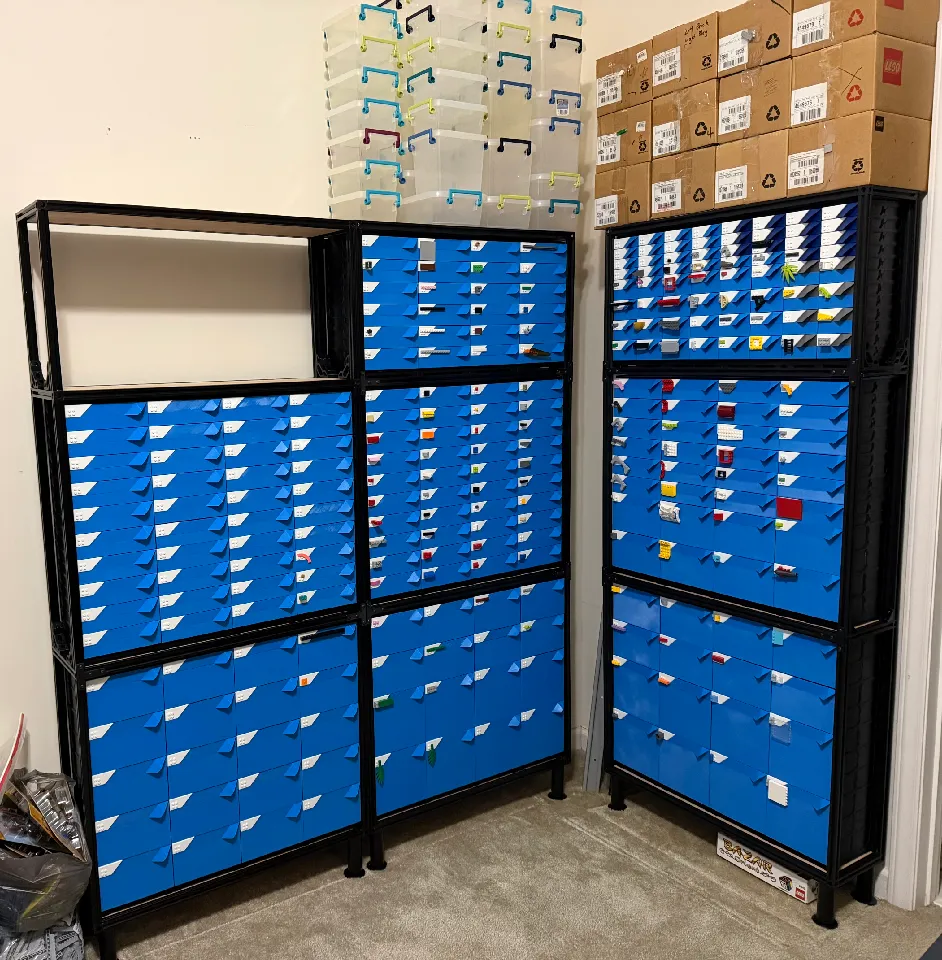
- The system
- MODULITH 185
- The frame
- 2020 aluminum extrusion, 800 mm stock
- The finishing touch
- Brick-shaped drawer labels
Getting to the bricks should not mean moving the bins.
What were you sorting with before?
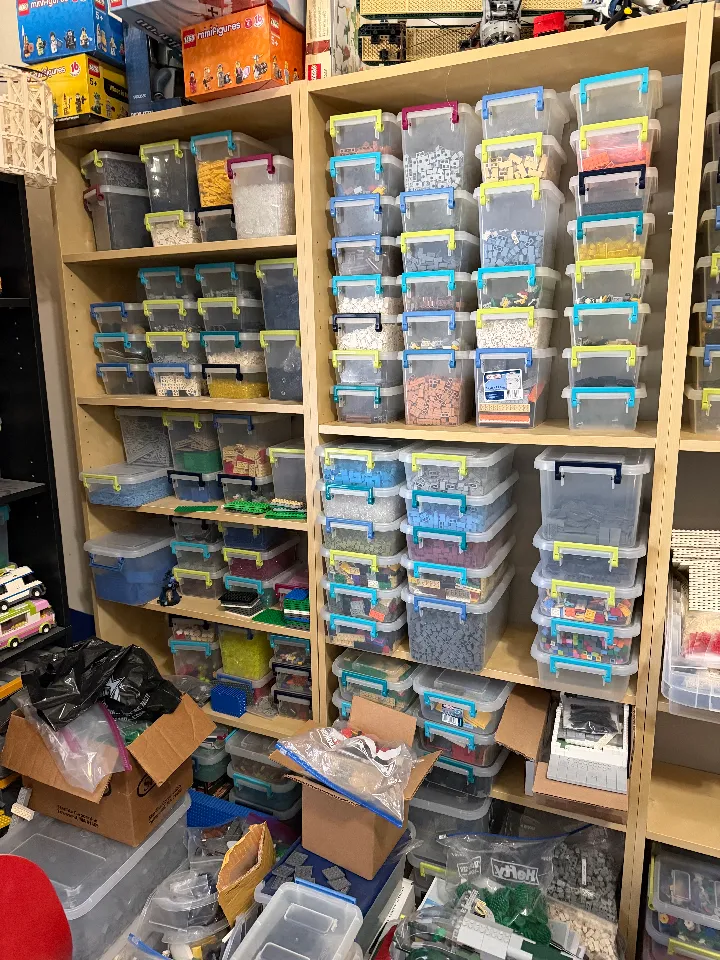
dlarson008: For over a decade, I relied on off-the-shelf IKEA bookshelves stuffed to the gills with standard Sterilite latching bins. They worked... until they didn't. They were discontinued, for one, but the real issue was efficiency. Bin-stacking means playing desktop Jenga every time you need a part buried at the bottom. Plus, the physical geometry of off-the-shelf tubs leaves dead space: acres of empty air inside generic bookcases.
I needed a modular drawer setup that maximized density, eliminated the "unstacking dance," and wouldn't bend particle board under load.
Why these drawers, and why the 185 depth?
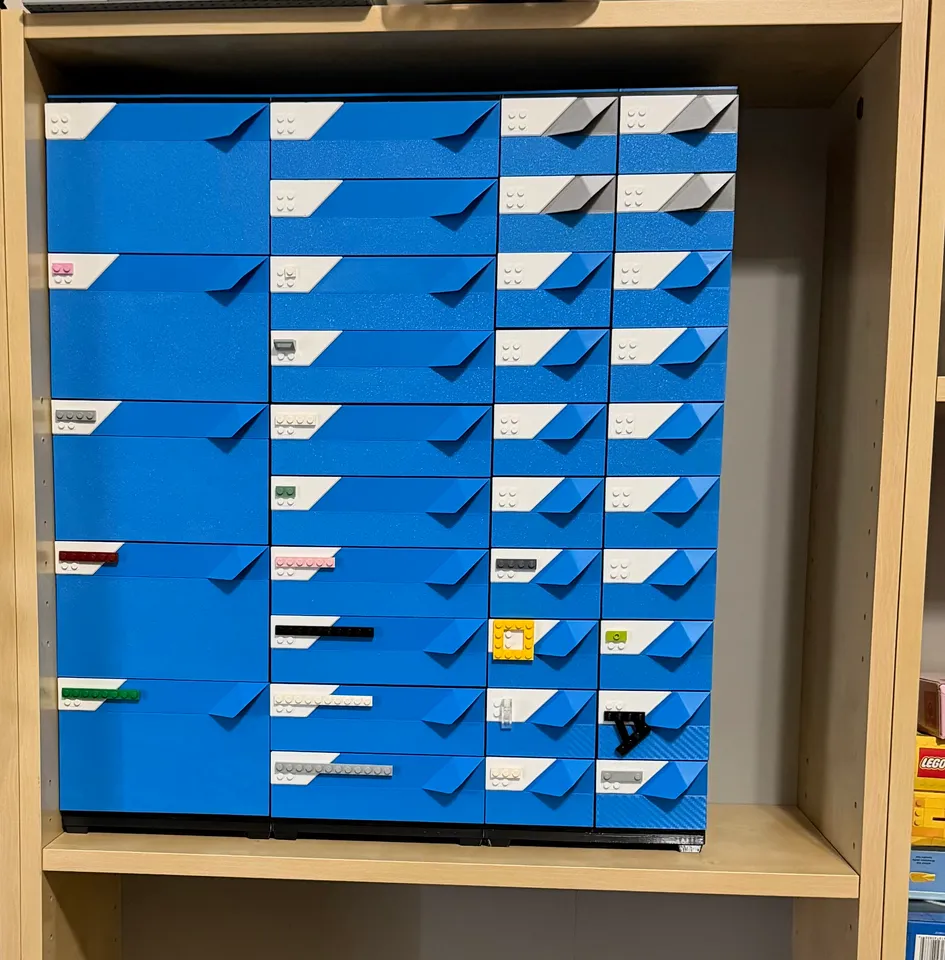
dlarson008: I settled on the Jerrari GEN2 modular 3D-printed drawer system. A 2W × 1H × 185 mm deep drawer unit perfectly matched the volumetric footprint of my old Sterilite tubs.
If I dropped a 6W × 8H × 185D footprint straight into my IKEA frames, I'd still bleed massive dead space, and those cheap shelves were already visibly bowing under the sheer weight of plastic bricks. Loading thousands more parts would be catastrophic. I needed a custom rig, built tough.
A frame built around the drawers.
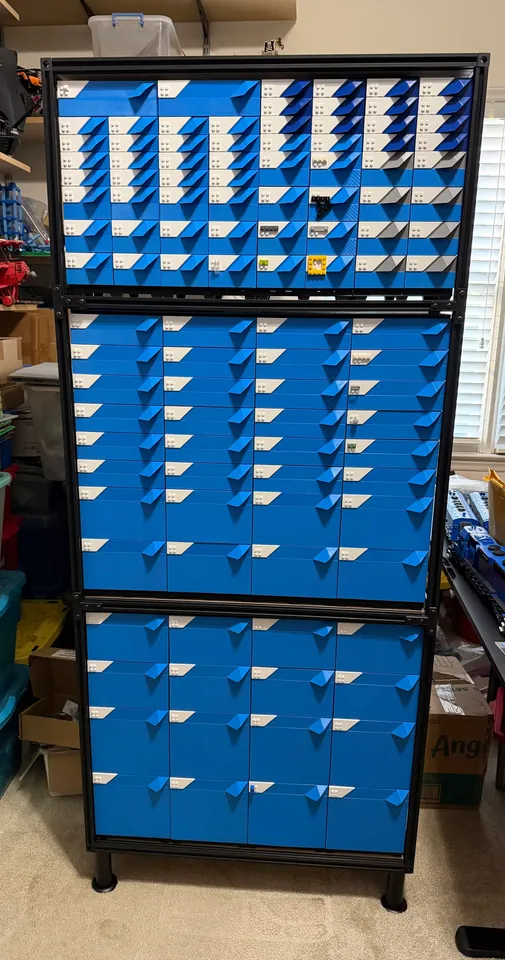
How did you land on sections of eight wide by ten high?
dlarson008: I pivoted to standard 2020 T-slot aluminum extrusions.
- Stock efficiency: I engineered around standard 800 mm lengths of 2020 extrusion to minimize scrap waste.
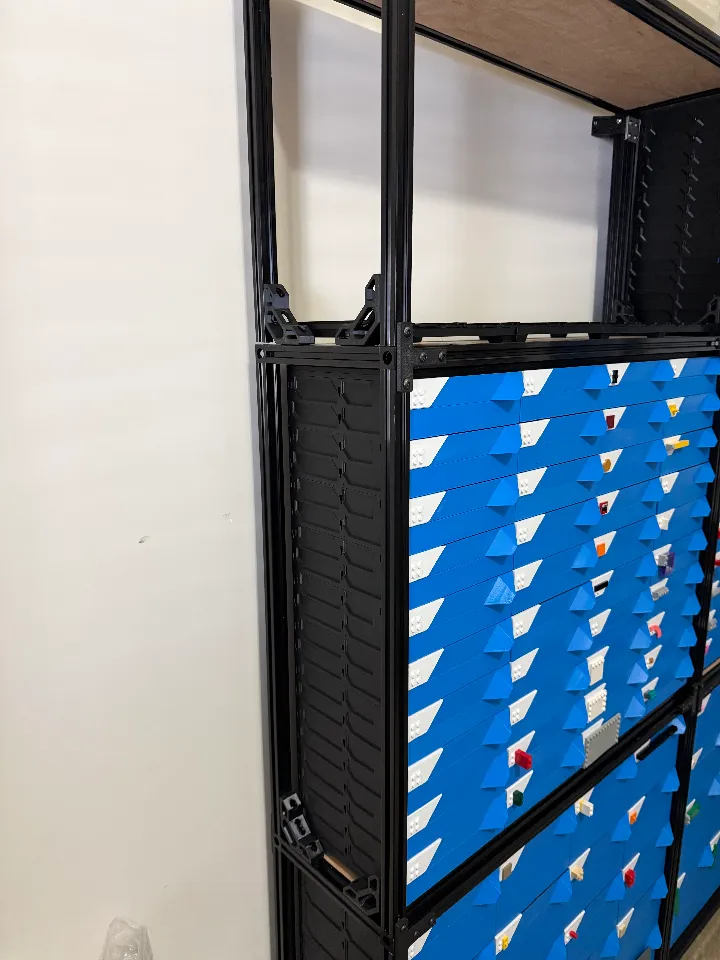
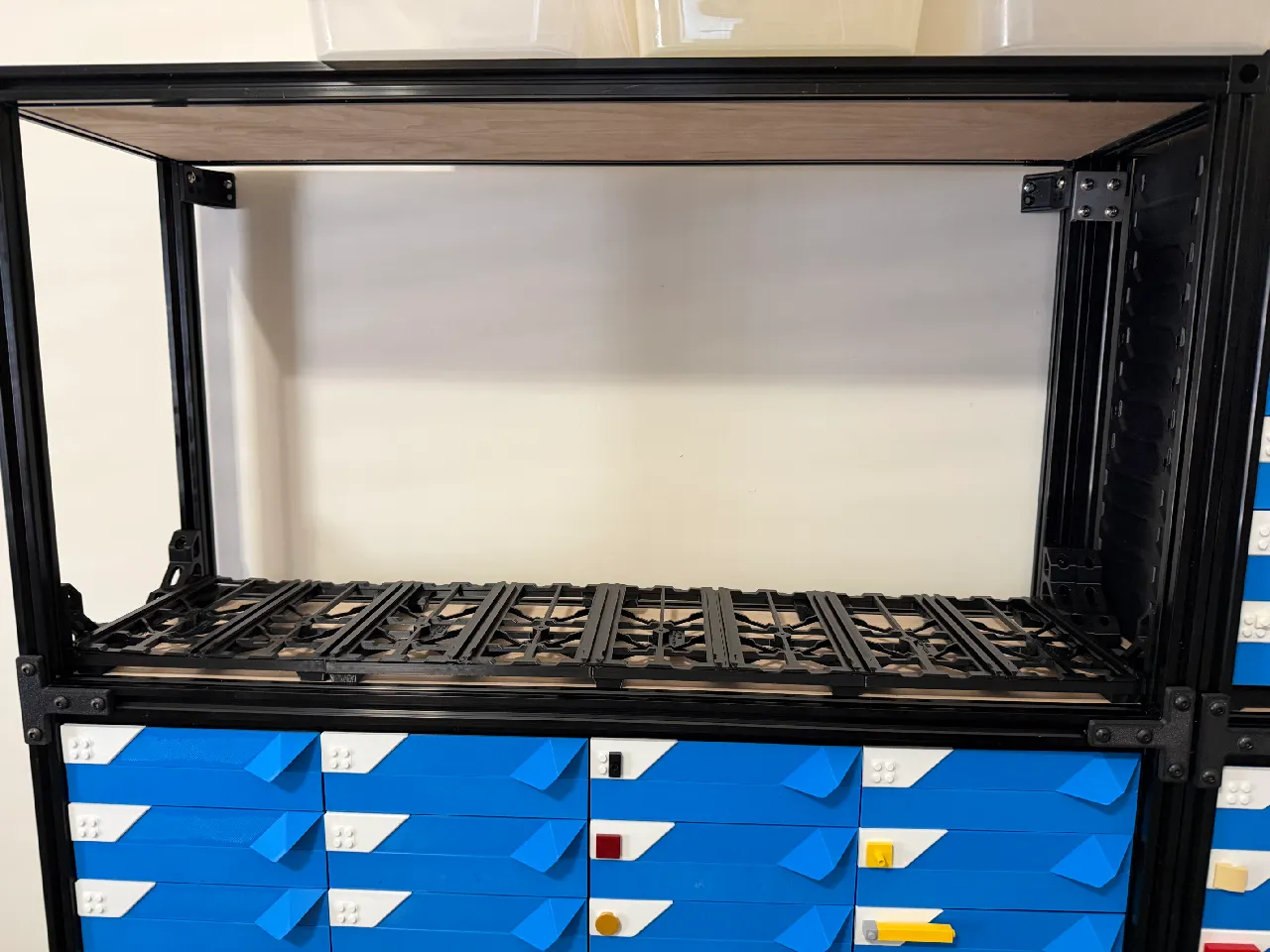
- Modular stacking: A single bay runs three modular tiers: two 8W × 10H frame units capped by an 8W × 6H unit (going any higher made the rig top-heavy). A full set takes just 18 cut pieces of 800 mm stock.
The structure behind the storage.
A full shelf of bricks is heavy. What carries the load?
dlarson008: A fully packed brick array weighs around 80 lbs per shelf. Standard 2020 aluminum spans will flex under that kind of load, so I built a hybrid structural skin:
- Torsion panels: I cut ¾-inch cabinet-grade plywood panels and rabbeted the edges to seat directly inside the 2020 extrusions. Once bolted down, the wood takes the shear loads and rigidifies the frame completely.
- Vertical load transfer: The core joints use 3-way cube corner connectors so all gravity forces drive down through the vertical columns.
- Custom hardware and printing: The main shelf frames are held together with custom 3D-printed inner corner braces and external T-brackets printed out of high-temp PETG-GF (glass fiber). On my standalone test shelf, I ran out of metal corner cubes and custom-printed replacements out of ASA-CF (carbon fiber) for maximum rigidity.
- Leveling base: The unit sits on heavy-duty adjustable 4.7 to 7.08-inch metal leveling legs secured via T-nuts and wood screws.
Not all 2020 is the same.
Any advice for someone buying extrusion?
dlarson008: Not all 2020 (20 mm × 20 mm) extrusions are created equal, so watch your hardware specs carefully:
- European standard: Features a 6 mm slot and 5 mm core hole (perfect for tapping with an M6 thread).
- Asian market standard: Varies wildly. Usually a 5 mm or 6 mm slot with a 4 mm (M5 tap) or 5 mm core.
- Fractional/Imperial: Watch out for "1010" imperial extrusions (1 inch × 1 inch / 25.4 mm). They look similar but will not fit metric hardware or printed accessories.
More to store.
More drawers, for more bricks. More are being printed, Technic pieces are next in line, and another configuration is already in the works.
The build at a glance
- First build6 wide by 10 high, inside an IKEA shelf
- NowThree bays, each with two 8W × 10H tiers and one 8W × 6H
- Frame18 cuts of 800 mm 2020 stock per bay
- LoadAbout 80 lb per shelf when packed
- Panels¾ in cabinet-grade plywood, rabbeted into the slots
- Printed hardwarePETG-GF corner braces and T-brackets, ASA-CF corner cubes
- FeetAdjustable 4.7 to 7.08 in levelling legs on T-nuts
Build and photographs by dlarson008. dlarson008 on Printables
LEGO® is a trademark of the LEGO Group, which does not sponsor, authorize or endorse this site.
Start with a few drawers.
Cases, drawers and shelves are free files; some decorative faceplates are paid Club designs. Pick a starter build and make it fit the space you have; the Planner lays out any size and lists the exact parts. Built something of your own? Send it in. One build is featured here every month, and every build is welcome on the community wall.